


 Cart
Cart
 sales@molnova.com


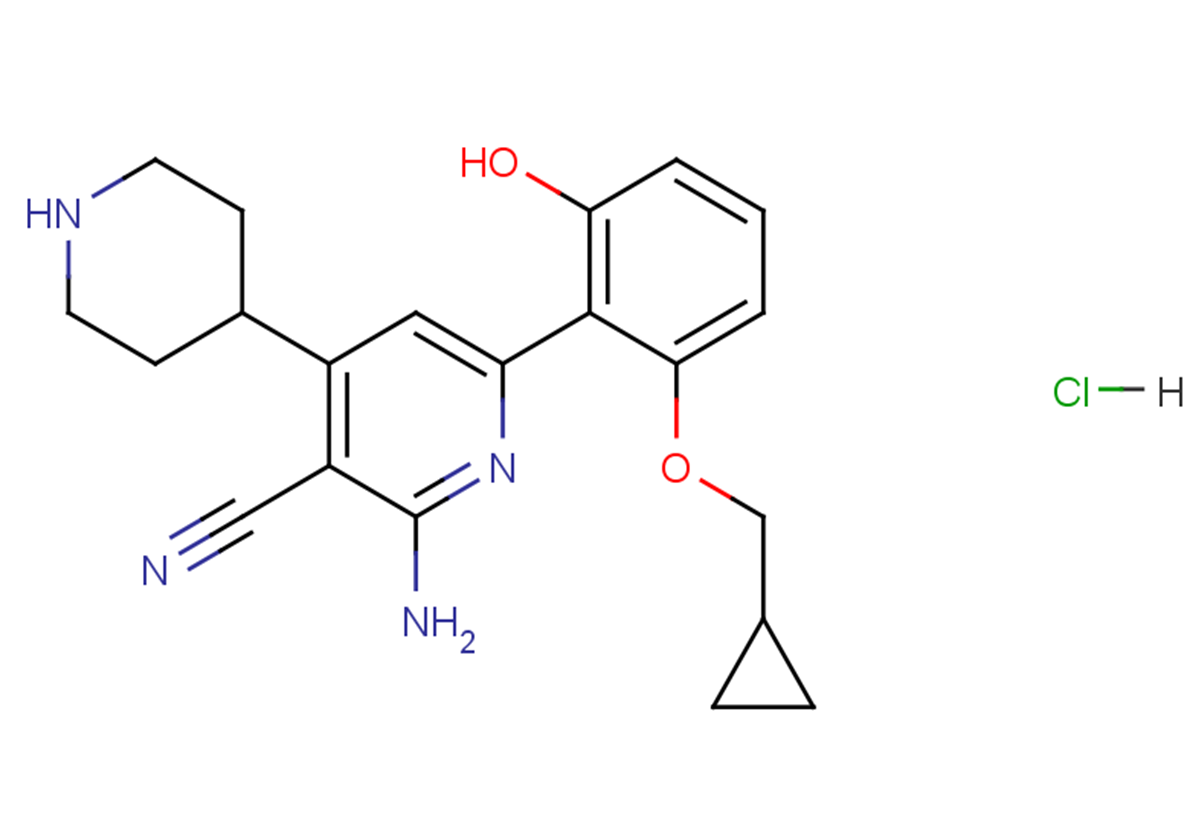
ACHP Hydrochloride
CAS No. 406209-26-5
ACHP Hydrochloride( IKK-2 Inhibitor VIII )
Catalog No. M24367 CAS No. 406209-26-5
ACHP Hydrochloride (IKK-2 Inhibitor VIII) is a highly potent and selective IKK-β inhibitor (IC50: 8.5 nM).
Purity : >98% (HPLC)
 COA
Datasheet
HNMR
HPLC
MSDS
Handing Instructions
COA
Datasheet
HNMR
HPLC
MSDS
Handing Instructions
| Size | Price / USD | Stock | Quantity |
| 5MG | 161 | In Stock |


|
| 10MG | 264 | In Stock |
|
| 25MG | 439 | In Stock |
|
| 50MG | 626 | In Stock |
|
| 100MG | 896 | In Stock |
|
| 500MG | 1791 | In Stock |
|
| 1G | Get Quote | In Stock |
|
Biological Information
-
Product NameACHP Hydrochloride
-
NoteResearch use only, not for human use.
-
Brief DescriptionACHP Hydrochloride (IKK-2 Inhibitor VIII) is a highly potent and selective IKK-β inhibitor (IC50: 8.5 nM).
-
DescriptionACHP Hydrochloride (IKK-2 Inhibitor VIII) is a highly potent and selective IKK-β inhibitor (IC50: 8.5 nM).
-
In VitroACHP Hydrochloride (Compound 4j) exhibits potent IKK-β inhibitory (IC50: 8.5 nM) and cellular activities (IC50=40 nM, in A549 cells). ACHP moderately inhibits IKK-α with an IC50 of 250 nM but exhibits good selectivity towards other kinases, such as IKK3, Syk and MKK4 (IC50>20,000 nM). Moreover, ACHP demonstrates quite potent activity in various cellular assays. ACHP inhibits NF-κB-dependent reporter gene activation in TNFα-activated HEK293 cells and PMA/calcium ionophore-activated Jurkat T cells. ACHP fails to inhibit PMA-induced AP-1 activation in MRC-5 cells and PMA/calcium ionophore induced NF-κB dependent reporter gene transcription in Jurkat cells even at concentrations exceeding 10 μM. ACHP selectively interferes with the NF-κB signaling cascade by inhibition of IKK-β in living cells. ACHP inhibits the growth of these cells in a dose-dependent manner. Tax-active cell lines are more susceptible to ACHP than Tax-inactive cell lines and Jurkat (IC50 values in Tax-active cell lines, Tax-inactive cell lines or Jurkat are 3.1±1.3?μM, 10.7±1.7?μM and 23.6?μM, respectively), suggesting that the growth of Tax-active cells depends on NF-κB more than Tax-inactive cells.
-
In VivoACHP (Compound 4j) is orally bioavailable in mice and rats and demonstrates significant in vivo activity in anti-inflammatory models (arachidonic acid-induced mouse ear edema model). ACHP has reasonable aqueous solubility (0.12 mg/mL in pH 7.4 isotonic buffer) and excellent Caco-2 permeability (Papp 62.3×10⁻⁷ cm/s), and demonstrates orally bioavailability in mice (BA: 16%) and rats (BA: 60%). The favourable bioavailability of ACHP in rats is likely due to its low clearance (0.33 L/h/kg). In an acute inflammation model, ACHP exhibits oral efficacy at 1 mg/kg in a dose-dependent manner.
-
SynonymsIKK-2 Inhibitor VIII
-
PathwayOthers
-
TargetOther Targets
-
RecptorIKKα|IKKβ
-
Research Area——
-
Indication——
Chemical Information
-
CAS Number406209-26-5
-
Formula Weight400.9
-
Molecular FormulaC21H25ClN4O2
-
Purity>98% (HPLC)
-
SolubilityDMSO:45 mg/mL (112.25 mM; Need ultrasonic)
-
SMILESN#CC1=C(C=C(N=C1N)C2=C(C=CC=C2OCC3CC3)O)C4CCNCC4.[H]Cl
-
Chemical Name——
Shipping & Storage Information
-
Storage(-20℃)
-
ShippingWith Ice Pack
-
Stability≥ 2 years
Reference
1.Murata T, et al. Synthesis and structure-activity relationships of novel IKK-beta inhibitors. Part 3: Orally active anti-inflammatory agents. Bioorg Med Chem Lett. 2004 Aug 2;14(15):4019-22.
molnova catalog



related products
-
WAY-324820-A
WAY-324820-A can be used as a QSAR model to study methionine aminopeptidase inhibitor as an anticancer agent using multiple linear regression.
-
Buddlejasaponin IV
Buddlejasaponin IV has analgesic and anti-inflammatory effects, the inhibitions of the expressions of iNOS, COX-2, TNF-alpha, IL-1beta and IL-6 by blocking NF-kappaB activation.
-
S1PR1 modulator 1
S1PR1 modulator 1 is a selective inhibitor of S1PR1 with a pIC50 of 7.6.
